 Chamber Culture
Chamber Culture
Chamber Culture
Most member churn is decided months before the renewal invoice goes out, and most chambers only find out at the invoice. This guide covers why members actually leave, the four signals that predict it early, and how to turn those signals into a check-in call instead of a lapsed-member email. At the end we show how Chamber Culture CRM runs this workflow automatically.
By Kevin Champlin, founder of Champlin Enterprises, builder of Chamber Culture CRM. · Reviewed: September 2026.
Ask a chamber why a member didn't renew and the answer is usually "budget," because that's the reason a member gives when they cancel a subscription they've already stopped using. The dues amount is rarely the real cause. What precedes most non-renewals is a member who quietly stopped getting value long before the invoice arrived: they stopped showing up, stopped opening the newsletter, and the one person at the business who cared about the chamber moved on or left.
That's the core problem with treating retention as a renewal-season task. By the time an invoice goes unpaid, the member has usually already decided. Retention has to be a year-round habit built on the same signals that predict an upgrade candidate, just read the other direction.
The same continuous tracking that finds a chamber's best upgrade candidates finds members about to lapse, and the warning signs show up early enough to act on:
Any one of these on its own is worth a check-in call. Two or more together mean the member has effectively already left, and the renewal invoice is just the paperwork catching up.
Spotting a warning sign only helps if it turns into an action, and that's where most chambers' retention efforts fall apart: the signal exists somewhere in a spreadsheet, a mail platform's open report, and a payment ledger, none of which talk to each other, and nobody is tasked with checking all three every week.
A member who goes quiet in February shouldn't be discovered in November when the renewal notice bounces. Event attendance, email opens, and payment history need to be watched all year so a drifting member surfaces on a filtered list months before the renewal date, not the week of it.
A tag or a flag that nobody is assigned to act on is just decoration. The warning signs above only reduce churn if they generate an actual to-do, assigned to a person, with a deadline: call this member this week.
A lapsed-member email that goes out after the renewal date has already passed is closing the barn door. A phone call while the member is still active, even if attendance has dropped, reaches them while the relationship is still repairable. Save the mail-merge for members who are healthy; use a call for the ones showing warning signs.
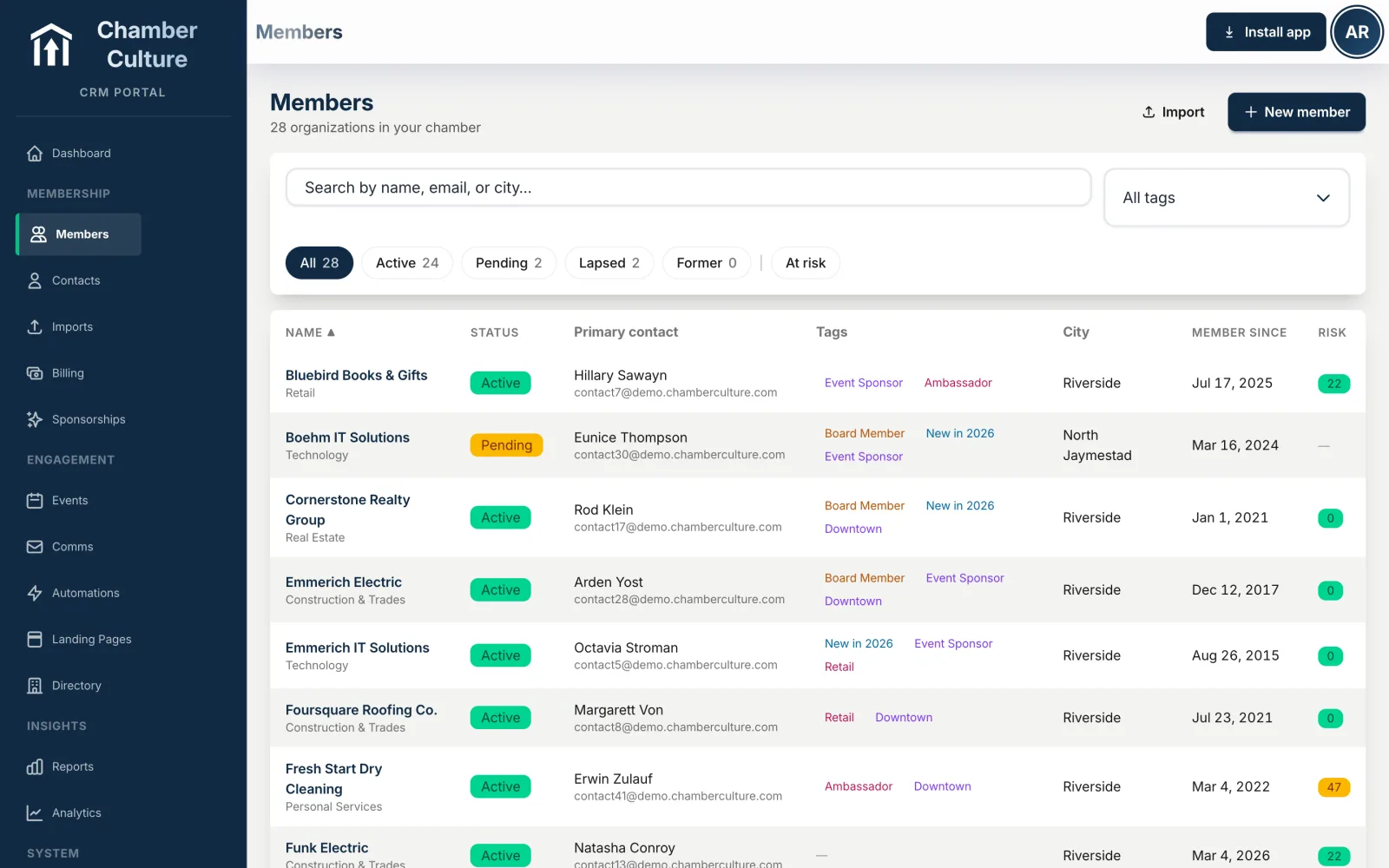
This is the same workflow above, built into the platform rather than left for staff to stitch together from three different tools:
If you're moving off a system that makes you track this by hand, see switching from GrowthZone, or try it on the live demo, no signup required.
Members rarely quit over the dues amount itself. The pattern that precedes most non-renewals is a member who stopped attending events, stopped opening chamber email, had dues go late for the first time, or lost the one internal contact person who valued the membership. Any of those on its own is a warning sign; two or more together mean the member has already mentally left, whether or not they have said so.
Four signals show up early enough to act on: no event attendance in six months, dues going late for the first time, no email opens, and the member's usual contact person leaving the business. Any one of these is worth a check-in call; catching a member before they lapse is worth more than any upsell, and it's far cheaper than replacing them.
Retention has to run all year, not appear the month before renewal. That means tracking event attendance, email opens and dues history continuously, so a member drifting away shows up on a filtered list months in advance instead of being discovered when the renewal invoice bounces back unpaid.
A check-in call works because it catches the member while the relationship is still repairable. By the time a lapsed-member email goes out after the renewal date has already passed, the member has typically already decided, and an email rarely reverses a decision a phone call could have caught months earlier.
At-risk alerts, one-click filtering, and an auto-filling task board that turns a warning sign into a call.
Get started → See the live demo →