 Chamber Culture
Chamber Culture
Chamber Culture
An AMS (association management software) is all-in-one membership software — dues, events, email, and a member directory built in. A CRM (customer relationship management) is built to track relationships, contacts, and pipeline, and is flexible and modern but doesn't natively handle dues or a directory. An AMS runs a membership organization's operations; a general CRM manages relationships and must be customized to do the same.
By Kevin Champlin, founder of Champlin Enterprises, builder of Chamber Culture CRM. · Reviewed: September 2026.
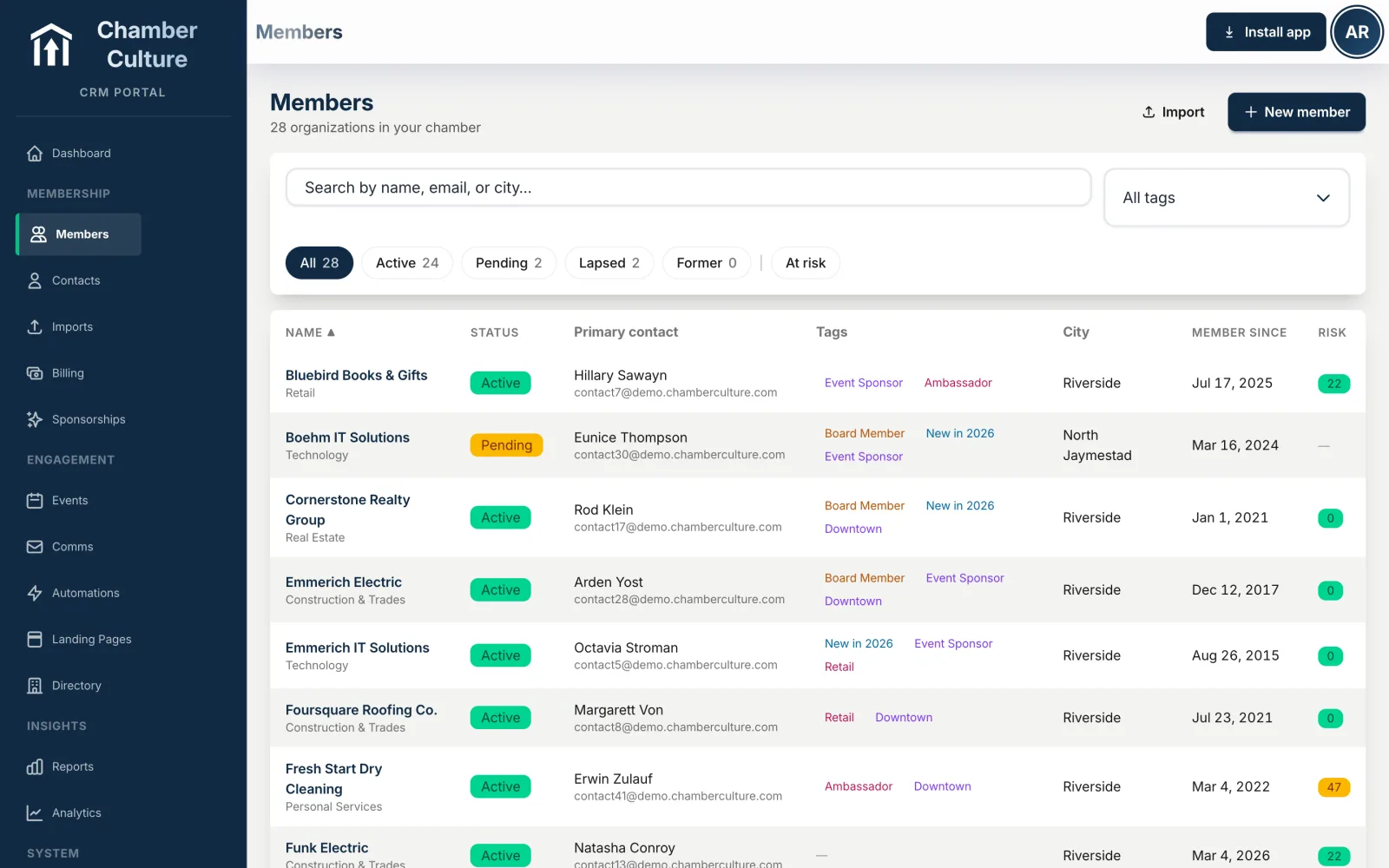
Association management software (AMS) is the operational backbone of a member-based organization. It is purpose-built around the concept of membership: a member joins, pays recurring dues, renews each year, attends events, and appears in a directory. An AMS handles all of that natively, without you configuring it from scratch.
For a chamber of commerce, "chamber management software" is simply an AMS tuned to chamber needs — member businesses, a public referral directory, ambassador programs, and sponsorship-heavy events. Its strength is depth: dues, renewals, event ticketing, and reporting all ship in the box. Its historic weakness is the interface — many legacy AMS products were built years ago and feel click-heavy and dated to a modern staffer.
Customer relationship management (CRM) software began as a tool for sales teams: track people and companies, log every interaction, and move opportunities through a pipeline. General-purpose CRMs like Salesforce and HubSpot are powerful, flexible, and modern — and that flexibility is the point.
But that same generality is the catch for a chamber. A raw CRM doesn't know what a "membership" is, can't bill recurring dues out of the box, and has no public member directory. You can add those things — with paid modules, integrations, or custom development — but you are building the membership layer yourself. A CRM manages relationships beautifully; it does not, by default, run a membership organization.
The same data, three philosophies. Here's how a traditional AMS, a general CRM, and a modern chamber-first platform compare on what chambers actually need.
| What matters | Traditional AMS | General CRM | Modern chamber platform |
|---|---|---|---|
| Built for membership | Yes — native | No — must be built | Yes — chamber-first |
| Dues & renewals | Native, recurring | Add-on / custom | Native, automated |
| Events & check-in | Registration & ticketing | Rarely native | Registration + QR check-in |
| Public member directory | Yes, often dated | Not included | Live, searchable, synced |
| Interface & ease | Often dated, click-heavy | Modern, but complex to fit | Modern & low-click |
| AI assistance | Added late, limited | Varies by add-on | Woven in from day one |
| Setup effort | Moderate to heavy | Heavy — you build membership | Guided, ready for chambers |
| Pricing transparency | Usually quote-gated | Per-seat, adds up | Published, from $150/mo |
Comparison is a general characterization of software categories, not specific products, and reflects publicly reported information for evaluation purposes. Individual products vary.
The honest answer for most chambers is membership-native software — an AMS or a modern chamber platform — because dues, renewals, events, and a directory are the job. A raw CRM only makes sense in narrow cases. A quick way to decide:
New to the category as a whole? Start with our primer: What is chamber management software?
The reason the name is "CRM" but the product does the AMS job is deliberate: Chamber Culture CRM is a chamber-first platform that blends both. It gives you a CRM's ease — a clean, fast, modern interface your staff and board can learn in an afternoon — while natively handling the AMS essentials a chamber can't live without.
In other words, you don't have to choose between the modern feel of a CRM and the membership depth of an AMS. See how it compares to the legacy incumbents on our comparison hub and the detailed ChamberMaster comparison, or check the published pricing.
An AMS (association management software) is an all-in-one system built for member organizations — membership records, dues billing, events, email, and a public directory out of the box. A CRM (customer relationship management) is built to track relationships, contacts, and pipeline; it's flexible and modern but doesn't natively understand dues, renewals, or a member directory. An AMS runs the operations of a membership organization; a general CRM manages relationships and must be heavily customized to do the same.
Historically chambers use an AMS, because dues, events, and a member directory are core to how a chamber operates and an AMS handles all of that natively. A general-purpose CRM like Salesforce or HubSpot can be adapted, but it takes significant configuration. The modern trend is a chamber-first platform that combines a CRM's ease with an AMS's membership depth.
A general CRM can replace an AMS only if you build the missing membership pieces — recurring dues, renewals, a public directory, and event management — on top of it, which usually means paid add-ons or custom development. A purpose-built chamber platform gives you those features without the build, which is why most chambers choose membership-native software.
Both, by design. Chamber Culture CRM is a chamber-first platform that blends the two: it feels like a modern CRM — clean, fast, easy to learn — while natively handling the AMS essentials chambers need, including dues and renewals, events with check-in, email, and a live searchable member directory, with AI woven in from day one.
A modern CRM interface with true membership depth — dues, events, a live directory, and AI included.
Get started →