 Chamber Culture
Chamber Culture
Chamber Culture
Chamber management software should run your whole chamber from one place — members, dues, events, email, and your public directory — without the spreadsheets, the extra tools, or the "request a quote." Chamber Culture CRM is the modern, AI-native way to do it: published pricing from $150/mo, fast human support, and AI woven in from day one, at a fraction of what legacy AMS costs.
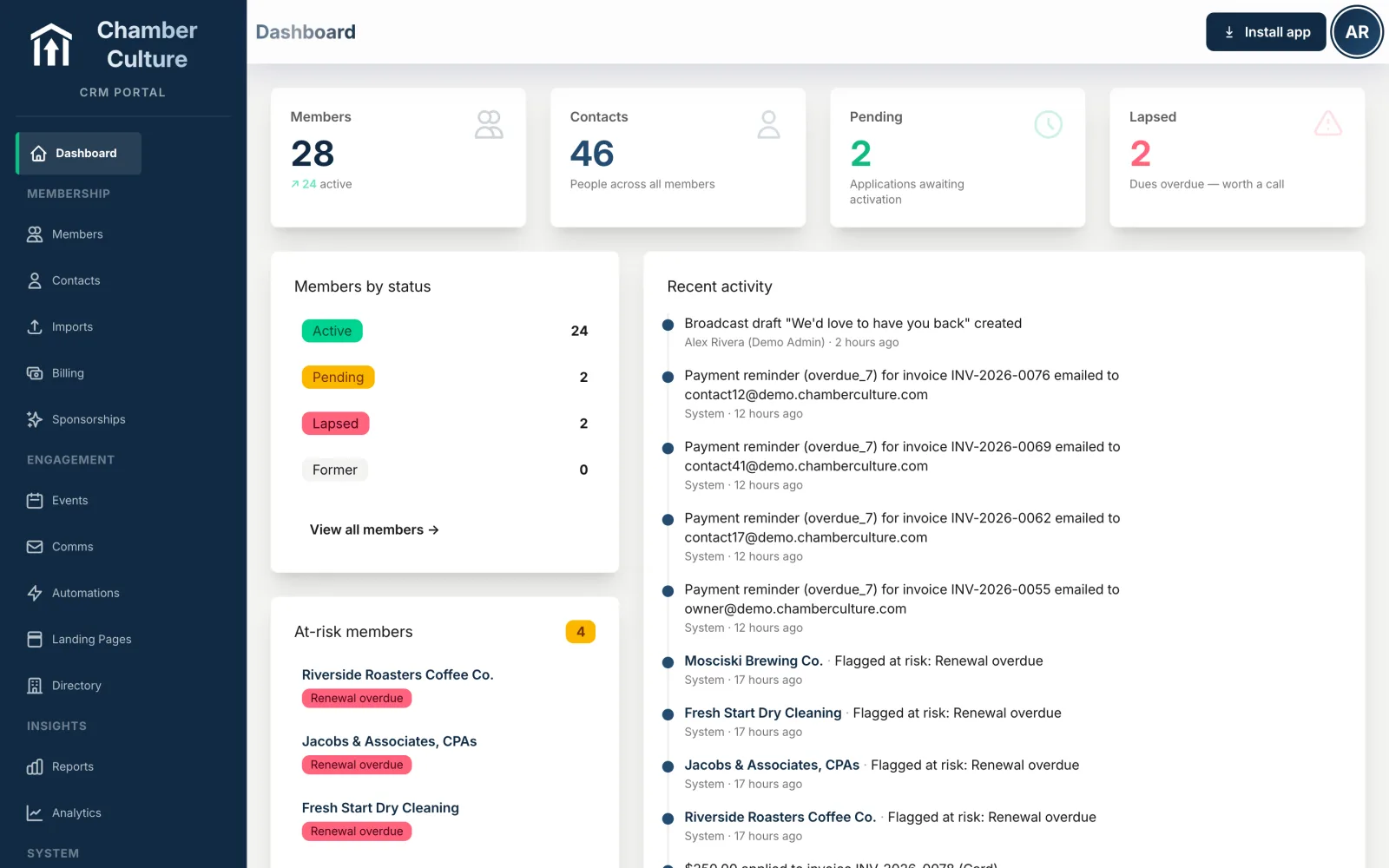
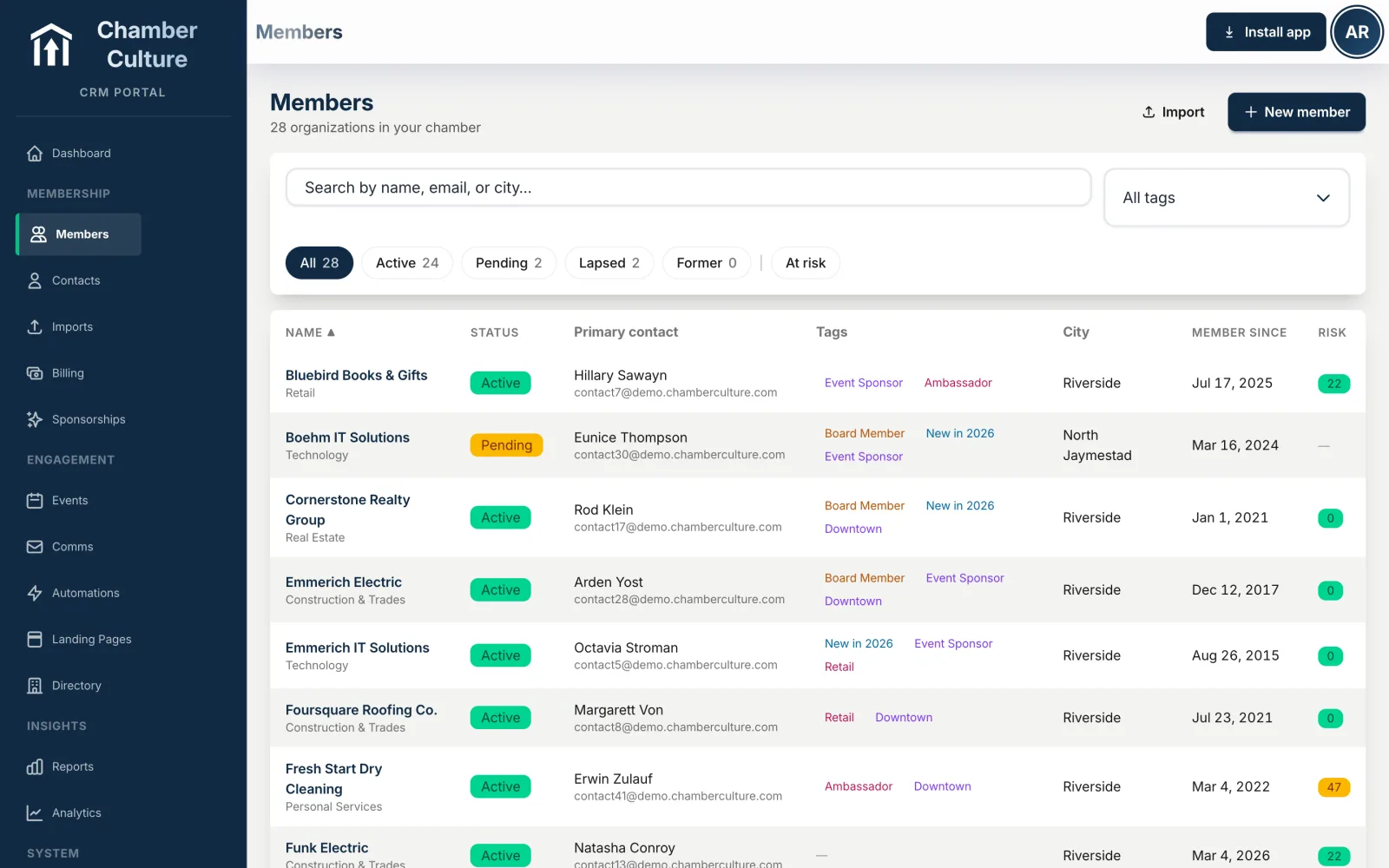
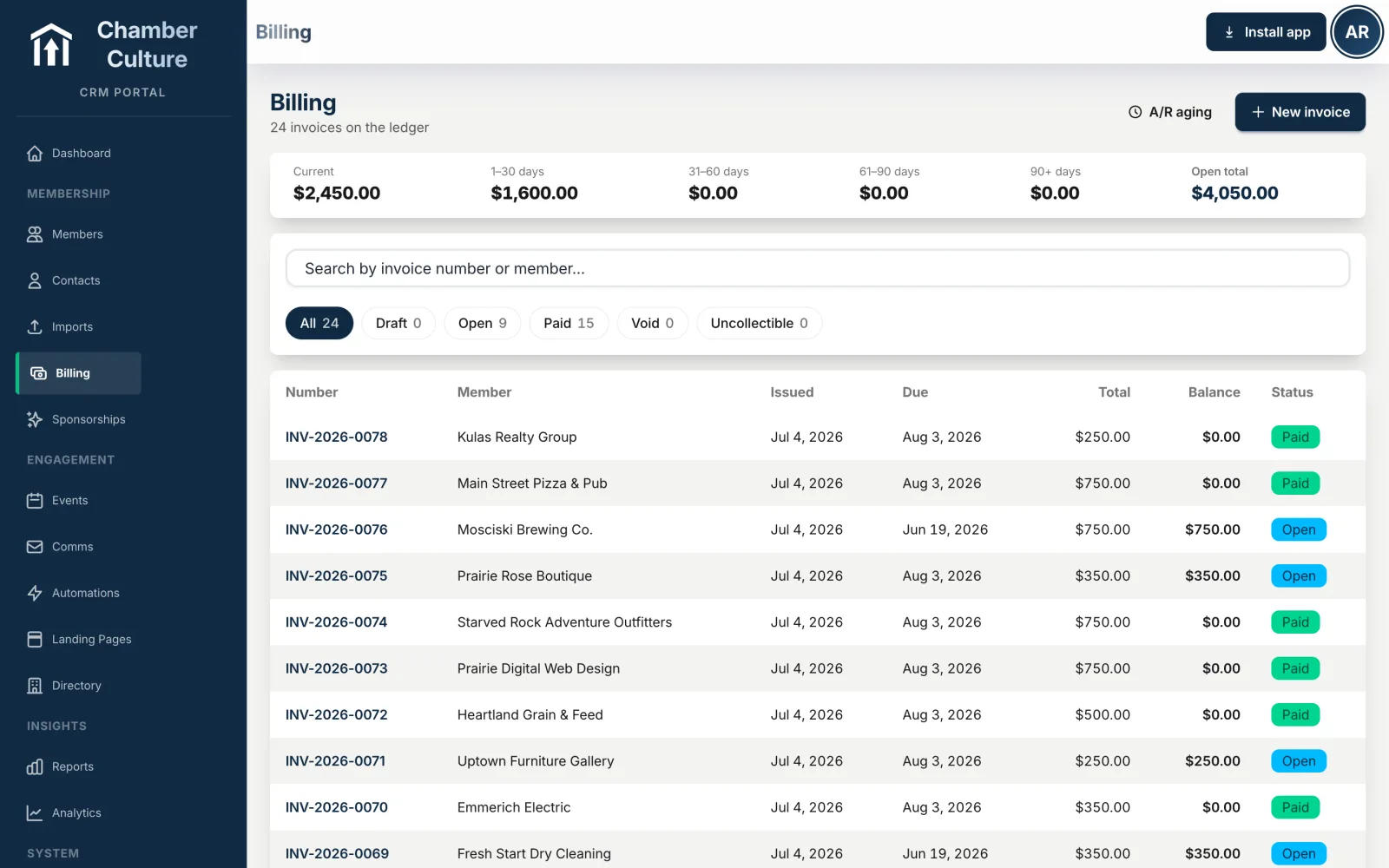
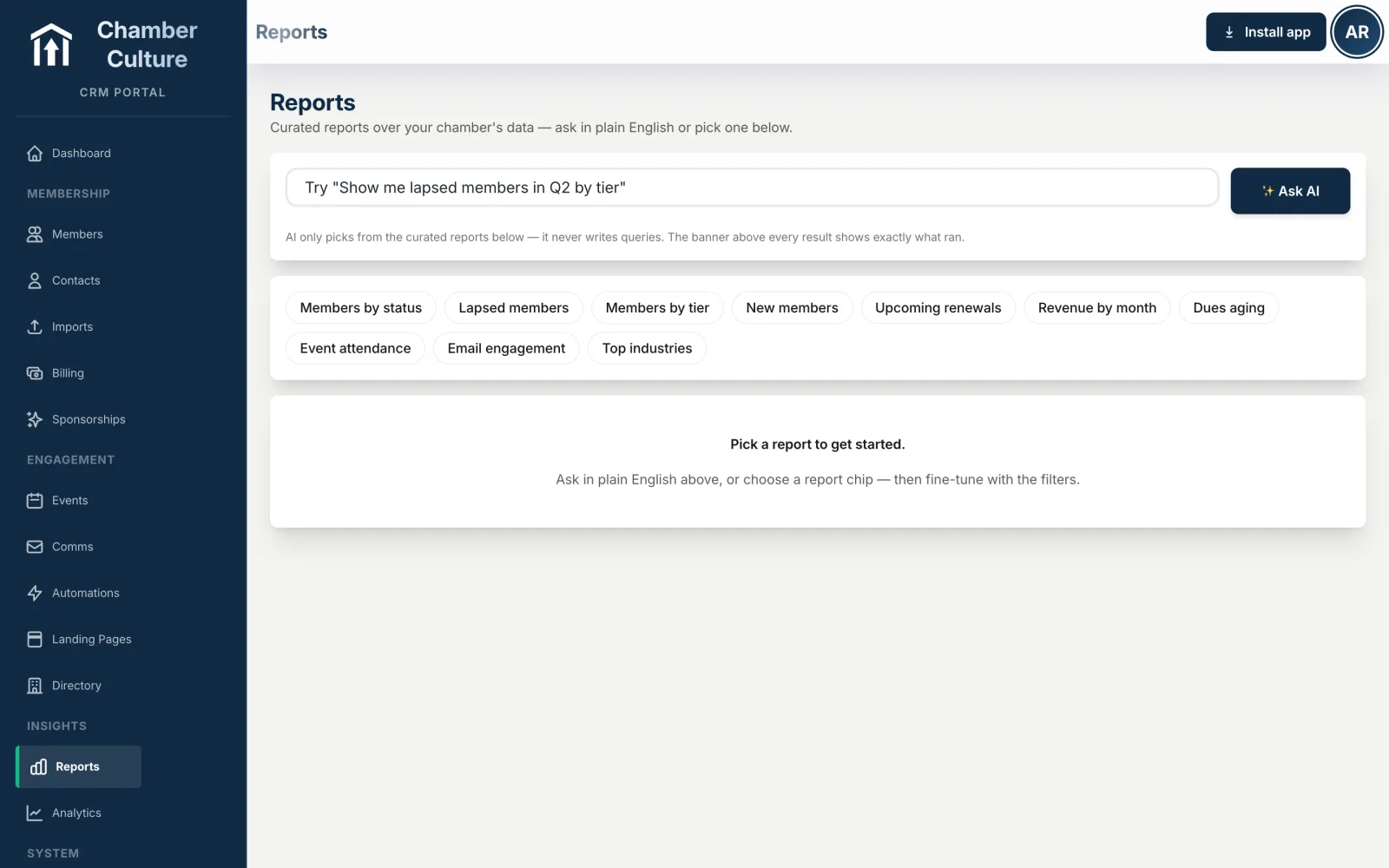
Chamber management software, or chamber of commerce software, is the single system that runs a chamber of commerce — member CRM, dues and billing, events, email, and a public directory in one place. Chamber Culture CRM does all of that with transparent pricing, a modern interface, and AI built in — not bolted on years later like the incumbents.
A plain-English definition for boards, executive directors, and anyone comparing platforms.
Chamber management software is an all-in-one platform that runs the operational work of a chamber of commerce — the member database, dues and invoicing, event registration and check-in, email and communications, and a public member directory — from a single system instead of a pile of disconnected tools. Chamber of commerce software is the same category by another name, and it is a chamber-specific type of association management software (AMS), tuned for how chambers actually operate: member businesses rather than individual members, sponsorships and events as core revenue, and a public directory that doubles as a member benefit.
Most chambers arrive at this software the hard way. They start with a spreadsheet of members, add a separate email tool, a standalone payment processor, an events app, and maybe a directory plugin on the website — then spend hours every week copying data between them and reconciling who paid, who renewed, and who showed up. Good chamber management software collapses that stack into one place, so a member record, their dues history, their event attendance, and their directory listing all live together and update each other automatically. When the data is unified, so is the work: one search finds a member, one screen shows their whole relationship, and one staffer can cover for another without a handoff document.
The category has been dominated for years by legacy incumbents — ChamberMaster and its parent GrowthZone chief among them. They are proven and feature-rich, but they were architected in an earlier era: quote-gated pricing, interfaces that "feel like 2005," and AI added late as an afterthought. Chamber Culture CRM is the modern answer — the same core jobs, rebuilt this year with published pricing, a fast low-click interface, and AI woven through the product from day one.
Switching software is the part chambers dread, and it's where legacy platforms quietly lock you in with annual contracts and proprietary exports. Modern chamber management software should make leaving as easy as joining: guided migration that maps your existing member fields, a dry-run preview before anything goes live, one-click rollback if something looks wrong, and month-to-month terms so you're never trapped by a renewal date. A platform confident in its product doesn't need a contract to keep you — it earns the next month every month.
Shopping the whole category rather than a single vendor? See our honest, side-by-side guide to the best chamber of commerce software, covering GrowthZone, MemberClicks, Wild Apricot, Glue Up, Novi AMS, MembershipWorks, ChamberHive, and Chamber Culture.
Three phrases, one category. The difference that matters is not the noun, it is whether you are buying one connected system or several products sold together.
A chamber management system is the platform a chamber of commerce runs its operations on: the member database, dues and invoicing, event registration and check-in, communications, and the public member directory, all in one place. That is the same definition as chamber management software. Buyers and vendors use the two interchangeably, and "system" tends to be the word a chamber reaches for when it is describing the whole operational stack rather than shopping for a single tool. If you searched for one and landed on the other, you are in the right place.
"Chamber CRM" is the narrower of the three. A CRM is the member-relationship layer: who your members are, who works there, what you have talked about, and where they are in the renewal cycle. In a legacy stack that layer is often a separate product from billing and events, which is exactly why chambers end up reconciling three exports every month. In a real chamber management system it is one record. We wrote up the distinction in detail on the chamber CRM page.
So the useful question when comparing platforms is not "is this a system or a suite," it is whether a change in one place shows up everywhere it should. When a member updates their address, does the directory listing change, does the next invoice go to the right place, and does the event badge print correctly, without anyone touching a second screen? In a single connected system, yes. In a bundle of products that share a login, the staff are the integration, and that labour never appears on the quote.
The second question, and the one that has changed most recently, is what the system does on its own. A chamber management system built this decade should draft the renewal email, answer a reporting question in plain English, and flag the member who is drifting before the invoice comes back unpaid. That is the subject of our AI chamber management software page, and it is the clearest line between a modern system and a well-maintained old one.
Take this into any demo. Anything a platform cannot show you in ten minutes is either an add-on or a roadmap item.
Shopping chamber of commerce software by vendor rather than by capability? The best chamber of commerce software roundup puts the named platforms side by side on exactly these points.
Chambers usually arrive at this looking for “membership management software” and find tools built for gyms, clubs and professional associations. Those stop short in the same place every time: they model a member as a person, when a chamber member is a business with several people beneath it, its own dues schedule, and a public listing. That is a subject in its own right, so it has its own page: membership management software for chambers of commerce covers the roster, contacts and reps, dues and renewals, engagement, portal self-service and the directory.
Every chamber platform claims to be "all-in-one." Here are the seven things that phrase actually has to mean — and how Chamber Culture CRM handles each.
A real member database, not a spreadsheet: businesses, their contacts, staff, tags, notes, and full history in one record. Every dues payment, event, and email is attached to the member, so any staffer can pick up a relationship instantly.
Recurring dues, invoices, and renewals with your own Stripe account — you keep your negotiated rate, with no platform markup. Accounting exports work day one, and two-way live QuickBooks sync is on the roadmap.
Registration, ticketing, and a full QR check-in loop — poster to phone to ticket to camera — so the front table moves fast and attendance flows straight back onto each member's record. No clipboard, no re-keying.
Send newsletters, renewal reminders, and event invites to the right segment from inside the CRM — and let AI draft the copy in your chamber's voice. Write a first pass in seconds instead of staring at a blank screen every Monday.
A fast, public member directory that syncs live with your data — a member updates their record and their listing changes the same moment. It is both a member benefit and an SEO asset, not a stale page someone edits by hand.
Ask for the numbers in normal language and get the answer — renewal rate, revenue by category, event ROI — without wrestling a rigid report builder. The reports your board asks for, ready before the meeting.
The platform watches for the quiet signals of a member about to lapse — no event attendance, an unopened renewal, a missed payment — and flags them early, so you save the relationship before it's a cancellation.
Chamber Culture Sites gives you a premium, SEO-optimized member website with the live directory built in — a real site your members are proud of, not a legacy template CMS from a decade ago.
See every capability in depth on the full features page →
Legacy AMS platforms hide the price behind a demo request. We publish ours. Pricing is by chamber size, month-to-month, and it's the whole platform at every tier — same interface, same AI, same fast support.
| Plan | Chamber size | Price | What's included |
|---|---|---|---|
| Starter | Under 500 members | $150/mo | Members, dues, events, email, directory, reporting, at-risk alerts — everything. See software built for a small chamber → |
| Growth | 500–2,000 members | $300/mo | The same full platform, sized for a mid-market chamber's roster and volume. |
| Pro | 2,000–10,000 members | $500/mo | The same full platform for large chambers and regional associations. |
| Legacy AMS | GrowthZone / ChamberMaster | ~$4,000–$10,000+/yr, quote-gated | Price behind a demo request, plus setup fees and à-la-carte upcharges. |
Legacy figures reflect publicly reported chamber spend and vary by size and add-ons; incumbents do not publish list pricing. Chamber Culture CRM tiers are published, month-to-month, with no setup runaround. See full pricing →
Same category, two different eras. Here's where a modern platform and a legacy AMS (GrowthZone / ChamberMaster) stand on the things chambers actually weigh.
| What matters | Legacy AMS (GrowthZone / ChamberMaster) | Chamber Culture CRM |
|---|---|---|
| Pricing | Quote-gated, ~$4,000–$10,000+/yr, à-la-carte upcharges | Published $150–$500/mo |
| Support | Ticket waits of weeks — their most-cited complaint | Fast human support as a written promise |
| Interface | Dated interface, more clicks per task | Modern, fast, low-click — built this year |
| AI | Newsletter drafting only, added late | AI-native — drafting, reporting & at-risk alerts built in |
| Reporting | Rigid, hard to customize | Plain-English AI reporting |
| Events | Registration & ticketing | + QR check-in loop (poster → phone → ticket → camera) |
| Payments | Bundled processor with a markup on card fees | Bring your own gateway: Stripe, PayPal, Authorize.Net, Elavon, and for the Philippines Maya and PayMongo. Your rate, no markup, stored cards on Stripe, PayPal, Authorize.Net and Elavon |
| Contracts | Annual | Month-to-month, export everything, no lock-in |
| Member website | Legacy template CMS | Premium, SEO-optimized site (Chamber Culture Sites) |
| Culture surveys | Not offered | Employee-engagement surveys + Best Workplace certification |
GrowthZone and ChamberMaster are trademarks of their respective owner. Chamber Culture CRM is not affiliated with, endorsed by, or sponsored by GrowthZone or ChamberMaster. Comparison reflects publicly reported information and is provided for evaluation purposes. See the detailed breakdowns: vs ChamberMaster → · vs GrowthZone →
Matching the incumbents' checklist is table stakes. Three things set this apart — and two of them, legacy AMS simply don't have.
Most legacy platforms bolted a single AI feature — newsletter drafting — onto a decade-old core. Chamber Culture CRM was designed with AI running through it: drafting emails and event copy in your voice, plain-English reporting so you ask for numbers in normal language, and at-risk alerts that read the signals of a member about to lapse and flag them early. It's the difference between a feature you have to go find and an assistant working quietly in the background of everything you do.
Legacy AMS ship a template CMS that looks like the web did ten years ago. Chamber Culture Sites is a genuinely premium, SEO-optimized website for your chamber, with your live member directory built in — a site your members are proud to be listed on, that actually ranks and drives leads to them. It's the marketing asset a chamber website was always supposed to be.
This is the piece no other AMS has. Through Chamber Culture Surveys, your member businesses can run employee-engagement surveys and earn a Best Workplace certification — a real, defensible member benefit that helps them hire, and gives your chamber a story to tell that GrowthZone and ChamberMaster can't match. Member management and a premium website are included with the CRM, and the workplace-culture program comes from Chamber Culture Surveys: two products, one team.
Chamber management software is an all-in-one platform that runs the operational work of a chamber of commerce: a member database and CRM, dues and invoicing, event registration and check-in, email and communications, and a public member directory. It replaces the tangle of spreadsheets, a separate email tool, a payment processor, and an events app that most chambers otherwise stitch together. It's a chamber-focused type of association management software (AMS). Chamber Culture CRM is a modern, AI-native example with transparent published pricing from $150/mo.
Legacy chamber software and AMS platforms like GrowthZone and ChamberMaster are typically quote-gated and commonly reported at roughly $4,000–$10,000+ per year depending on size, plus setup fees and upcharges. Chamber Culture CRM publishes its pricing: $150/mo (under 500 members), $300/mo (500–2,000), $500/mo (2,000–10,000). No "request a quote," month-to-month. See pricing →
Good chamber management software should cover seven core jobs in one place: a member CRM with full history, dues and recurring billing (ideally with your own payment gateway and QuickBooks), event registration with fast check-in, email and communications, a searchable public directory that syncs live with your data, plain-English reporting, and proactive at-risk member alerts. Chamber Culture CRM does all seven, with AI woven into drafting, reporting, and renewals rather than bolted on late.
Yes. ChamberMaster (a GrowthZone product) is a proven, feature-rich incumbent — but it's quote-gated, has a dated interface, and adds AI late. Chamber Culture CRM is a modern, chamber-first alternative with transparent published pricing, fast human support, a modern low-click interface, AI built in from day one, guided migration, and month-to-month terms — plus a premium member website and workplace-culture surveys legacy AMS don't offer. See the full breakdowns for ChamberMaster and GrowthZone.
Yes. Chamber Culture CRM includes a fast, searchable public member directory that syncs live with your data — a member updates their record and their listing changes the same moment. Beyond the directory, Chamber Culture Sites delivers a premium, SEO-optimized member website that goes well past a legacy template CMS, with the live directory built in.
They are the same category. A chamber management system is the single platform a chamber runs its operations on: members, dues and invoicing, events and check-in, communications, and the public directory. "System," "software," and "platform" are used interchangeably by buyers and vendors alike. The distinction worth checking is not the word but the architecture: a real chamber management system keeps one member record that dues, events, email, and the directory all read from and write to, whereas a bundle keeps separate records your staff reconcile by hand.
Yes. Chamber Culture CRM lets you connect your own Stripe account for dues and event payments, so you keep your negotiated processing rate with no platform markup — unlike bundled processors that add a percentage on top. Accounting exports work from day one, and two-way live QuickBooks sync is on the roadmap.
Published pricing, fast support, and AI included — at a fraction of what legacy AMS costs.
Get started →